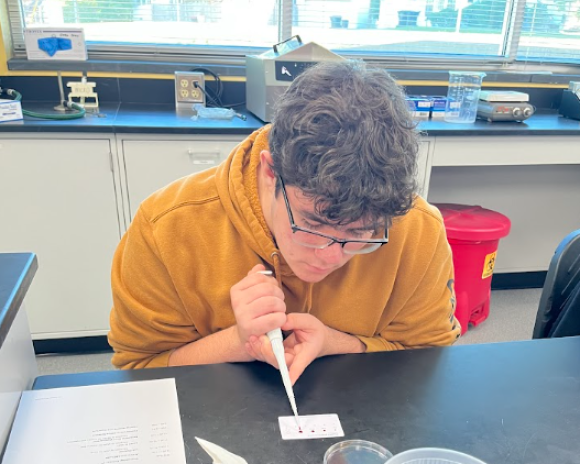
The Foundations of Biotech lab series was created to introduce students to biotech techniques and concepts. The in-depth labs have students explore recombinant DNA technology. These labs require many pieces of (sometimes expensive) scientific equipment.
As sites consider strategies to expand their reach with existing equipment, introductory kits may provide a solution. Introductory kits can be an effective tool for onboarding new teachers in a manageable way and maximizing the reach of existing equipment. Several sites have successfully integrated introductory kits into their offerings in innovative ways.
“Our introductory kits are currently built out as subsets of a full kit and are meant to cover the micropipetting lab, gel electrophoresis lab, and extension labs such as Dog Drool Investigation and pipette art,” explains Drew Spacht, ABE Central Ohio site coordinator. “We encourage all new teachers to start small by doing just these first few labs with their students. Even with everything pre-aliquoted and ready to use, ABE is a lot for new teachers, and a focused experience sets the stage for success. The way our kits are set up means we can essentially pull an intro kit out of a full kit—gel boxes are in one set of containers, pipettes and consumables in another set. The consumable containers are where specific lab requests are fulfilled, and materials are added or removed based on requests. This allows us to quickly cycle a kit from “full-service” to introductory, though we are building out dedicated introductory kits in the next grant cycle to allow for faster turnover.”
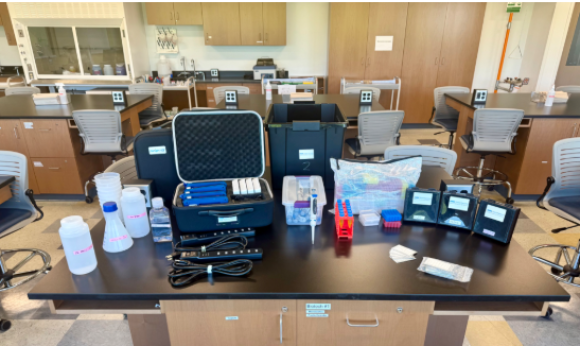
ABE Kentucky site technician Tyler Carroll, concurs: “Our introductory kit is a great way for new teachers to get involved with ABE without feeling overwhelmed. Oftentimes our teachers will be really interested in adopting our curriculum into their classrooms but hold themselves back for fear of not being able to manage the more in-depth labs. The introductory kits allow them to get a better feel for the equipment and managing a lab environment before they jump into the deep end of cloning, transformation, Exploring Precision Medicine, etc.”
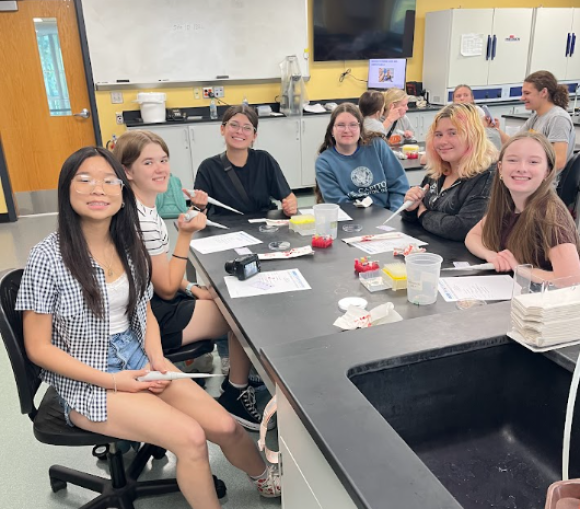
Phil Smith, ABE United Kingdom (UK) site coordinator, describes how rather than having a dedicated introductory kit, they have a full approach to training and equipment loan. Teachers and technicians who are new to ABE attend an introductory PDI covering micropipetting, plasmid digestion, ligation, and gel electrophoresis. The advanced PDI, offered the following year, adds PCR labs, bacterial transformation, and DNA profiling.
In the early days, the ABE UK site used separate loan boxes depending on whether advanced labs were included. However, this became limiting when more than one school requested advanced materials during the same loan period, leading the team to develop a “top-up-box” approach instead. This helps avoid overwhelming teachers and students. “Because our PDIs are single-day sessions, we have to be realistic about what fits in a day of training while still making it worthwhile for the teachers to be away from the classroom,” says Smith. “The approach encourages teachers to return the following year to continue building their skills and expand the labs they can offer students."
“We know that ABE generates excitement and skills in science. The efforts of our program sites to bring ABE to more teachers and students is truly inspirational,” says Rebecca Lewis, ABE Program Office Director. “The adaptation of Introductory kits is just one example of their innovative ideas to expand access to the biotech skills taught through ABE.”