As a biology tutor, Aya Barghachoun is constantly looking for ways to move beyond theory to create authentic scientific practice. While a physiotherapy student at the University of Sydney, she joined the ABE teacher training program, not realizing just how transformative that move would be.
A year later, Barghachoun has not only expanded her tutoring program to include hands-on ABE labs and curriculum through a partnership with ABE Australia, but has also switched her own major—transitioning into biotechnology and education. “The training reminded me why I fell in love with molecular biology in the first place,” she says. “ABE did not just influence my students; it reshaped my professional path, and I have never looked back.”
Barghachoun’s tutoring program, Enhance Education, works with a range of students to support their studies, especially in their final year of high school. Many of the students come from underserved populations, making the group a great partner for ABE Australia, “which is committed to improving its engagement of students and schools that are furthest from opportunity,” says Eugenia O’Brien, site coordinator at ABE Australia.
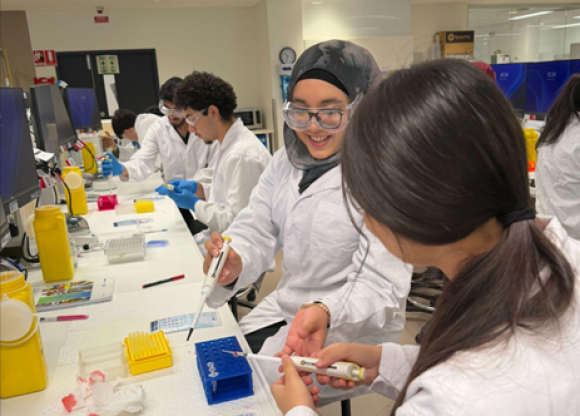
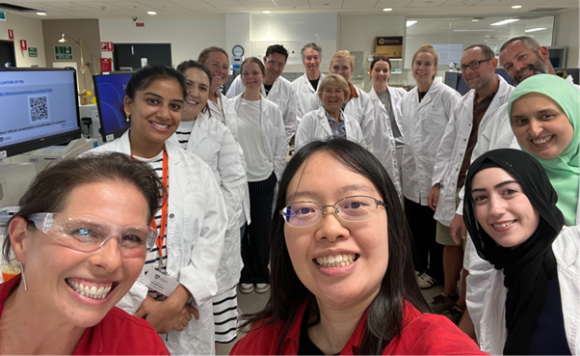
Already this year, a group of 60 students from Enhance Education, representing some 25 different schools, visited the University of Sydney to take part in ABE labs while they were on a holiday break. The visit was a great opportunity for the students to work in a dedicated lab space, as well as for the ABE Australia team to work directly with students.
“Student-faced teaching provided a new, fun and insightful opportunity for our team,” O’Brien says. “Being able to teach ABE labs directly to students gives us some insights into what works well, any elements that students find difficult to understand, what questions commonly arise, and which skills might need extra attention. We hope that this will make us better trainers of teachers and also help us teach students more effectively.”
For Barghachoun, the visit was an evolution of Enhance Education’s relationship with ABE from last year, when she first ran an electrophoresis lab in a single room tutoring center with 15 students crowded around classroom desks. “Despite the limited space, the excitement was extraordinary,” she says. “Students who had only seen DNA separation in textbooks were suddenly loading wells themselves and competing with who can pipette the dye into the well better.”
Now, that excitement has transformed into a longer-term educational collaboration that both Barghachoun and O’Brien hope will persist into the future. It has also opened up other opportunities for direct student training at the university, O’Brien says, with some of the Enhance Education students returning for more labs in separate outreach events with their schools. “We are looking forward to seeing the students again to check if their experience has given them some confidence with related material and skills,” she says.
Both Barghachoun and O’Brien want to continue to offer students from low socioeconomic status backgrounds the opportunity to make biology real. “Textbooks and practical experiences are not opposites, but they are complementary. Without hands-on experience, molecular biology can feel intangible and becomes a confusing concept that students have so many questions about,” Barghachoun says. “ABE labs make it tangible.”
From the 60-person university visit this year, the student feedback has already been tremendous. In a survey, three-quarters of students who said they had no understanding or some understanding of biotechnology theory prior to the workshop said that their understanding had improved to good or strong levels after it, and nearly 90 percent of students who noted that they were not confident or were somewhat confident in their lab skills reported increased confidence by the end of the workshop. Most students said they wanted even more lab practice time.
Looking at some individual stories, one participating student has decided to pivot his career toward genomics and molecular biology, Barghachoun says. “He had previously enjoyed biology, but the practical component allowed him to consider this as a long-term real profession rather than just a school subject.”
Another student, she says, became so inspired that she began researching how to start her own lab. After discovering the equipment would cost close to $500,000, she put that idea on hold and instead attempted to make agarose gel using gelatin at home which, Barghachoun says, “was an ambitious but unsuccessful attempt.” Barghachoun has now purchased agarose powder to prepare gels together at the tutoring center.
“That level of curiosity is exactly what I aim to cultivate,” Barghachoun says. As Enhance Education continues to grow, she now aims to make a university laboratory excursion an annual experience. But she emphasizes that ABE is more than just an excursion for the program: “It aligns directly with our long-term vision to integrate practical biology into after-school education and to build a culture where students do not just study science, but they practice it.”