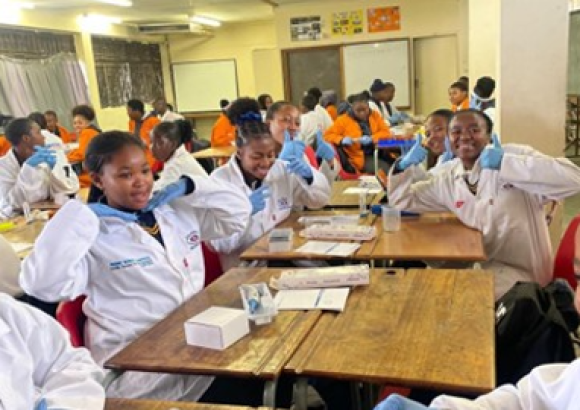
Listening to South African students Lesedi and Lilitha discuss their interests in science and plans to pursue medicine, it’s hard to believe they are only 15 and 16 years old. The confidence and passion with which they talk about biotechnology and healthcare—and how they plan to change the world—is infectious, and they say it stems from the Amgen Biotech Experience (ABE).
“Biotechnology has shifted my views on being a healthcare provider,” says Lesedi, a grade-11 student at Glenbrack High School, southeast of Johannesburg. “Before ABE, I really had a surface-level understanding of what healthcare providers can do. But through all that I've learned and experienced in this program, I see now that medicine goes beyond direct intervention, and now my interest in science has deepened.”
Similarly for 10th grader Lilitha, ABE showed her that biotechnology is more than just drug and vaccine development—it also contributes to food security, recycling waste, and addressing a host of other global challenges. “I also learned that there are many layers to medicine,” she says. “It helped me gain knowledge that I think will help me figure out how to help with solutions.”
Their teacher, Mrs. Iloms, could not be prouder. The goal of her work with the ABE labs at the school, in collaboration with the ABE South Africa site at the Science Centre at Sci-Bono, is to inspire and empower her students. “It's all about the lives I want to impact, the lives of my learners,” she says. “When we first started ABE, I told them, ‘You now have a golden opportunity, one I never had when I was in high school, and that’s truly rare on the African continent.’”
At Glenbrack, as at many of the participating schools in ABE South Africa, lab technicians from the Sci-Bono Science Center set up their mobile lab to help guide students through the hands-on activities. The program also trains teachers through professional development institutes, including a recent large workshop on electrophoresis with 172 educators.
The demand for such activities is growing, says Akash Dusrath of Sci-Bono, as the Provincial Education Department seeks “more hands-on and exciting” ways to reach students. “We want to help teachers develop more innovative and dynamic ways to deliver the curriculum in the classroom so that our learners will become more receptive to science,” Dusrath says.
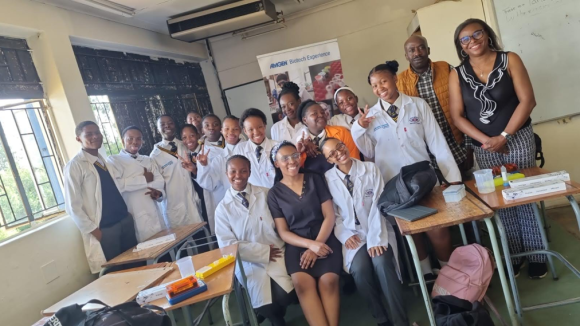
The community has been so receptive to the ABE labs that Iloms’s biggest complaint is that they are not a permanent part of her school. While she greatly values the mobile lab coming to meet with her and students after school, she looks forward to one day having a long-term, “proper lab” setup that can reach even more educators and learners. In the meantime, she is excited to see students like Lesedi and Lilitha embracing the life sciences.
With a master’s degree in environmental management and experience conducting research on municipal wastewater treatment plants in South Africa, Iloms brings a real-world perspective to her classroom. Learning to use a pipette and think through scientific questions are invaluable skills that she knows will inspire confidence and possibility in her students.
Even as she works to help them pursue their dreams, Iloms continues her own educational and professional growth—including pursuing a doctorate degree—further serving as a role model to her students. “Many of my learners say, ‘If ma’am can get a PhD while she's working, she's got a family, and she has all that responsibility to the district, then there's nothing stopping me,’” she says.
Indeed, there is nothing stopping Lesedi and Lilitha as they chart their own paths in science and healthcare. “I really want to be a part of the group of people that work to improve healthcare for people of color, for Black people,” Lesedi says. “With the rise in global temperatures and the rise in multifactorial, complex diseases, I want to be a part of the team that helps to find solutions.”
Says Lilitha: “Biotechnology creates career opportunities for people invested in this world, and it can also help a person make wise choices about using genetically modified foods or medical treatments. … I'll have so much knowledge about this field that I will be able to overcome any challenge I might face in the future.”