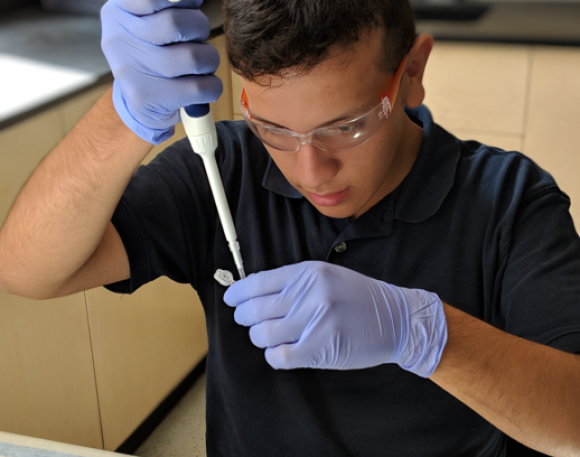
Last year, ABE Canada celebrated reaching 10,000 students. As impressive as that may sound, the metric that was even more remarkable to ABE teacher Janette Buckley was 5,000. That's the number of students the program has reached just since the 10,000-student milestone in spring 2025.
“I didn't realize how small the program used to be and how it's been growing and growing,” Buckley says. “And now to have reached 15,000 students from 10,000 in just a year is the type of growth I love to see from such a rich program.”
“It's been an exponential growth for sure,” says Kristina Han, site coordinator at ABE Canada at the University of Toronto Mississauga (UTM) and one of three ABE Master Lab Technicians. “The growth shows the need for hands-on labs in our high school classrooms, especially with shrinking budgets, particularly for field trips and extracurricular activities.” Much of the growth, Han says, is from teachers at existing schools expanding their ABE offerings to more grade levels and familiarizing other teachers at their school with the labs.
That’s certainly the case for Buckley, a science teacher at Saint John Paul II CSS Toronto, who has participated in ABE for 8 years. She has been proactive in both training new teachers at professional development institutes and coordinating the use of the ABE kit for multiple grades and classes at her school after borrowing it from UTM. She is so passionate about the hands-on lab work that she has also made it a family affair.
“ABE has become a family ritual,” Buckley says. In part because of the long travel time between where she lives and the university, she began taking her two kids with her to pick up the ABE kits from UTM. Over time, interest in the labs grew among her kids, and they also love seeing Han and interacting with her at the university.
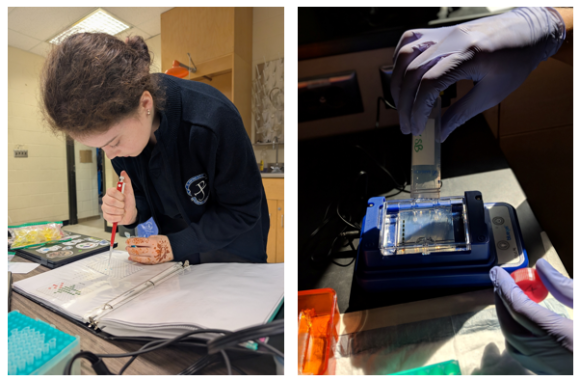
Buckley’s daughter, a 10th grader at Saint John Paul II, now often runs the pipetting art labs with 9th graders and her 10th-grade peers, which allows Buckley to run the ABE labs across so many different classrooms and all four grade levels. As her kids have become more active with ABE, she has seen growth in their leadership skills and confidence that mirrors, she says, growth she has seen in her students over the years.
“The labs give my students really good exposure to science, good prep for university, and some confidence,” Buckley reflects. “My best experimenters are often not my most academic kids and are not the ones who always feel the strongest and bravest in the classroom. If they get strong lab results because their technique is good, they have an increase in confidence, so it’s a really nice way to highlight that science isn’t just about who can memorize the most or do the best math.”
Over the past 20 years of teaching, Buckley’s own experiences with research have shaped the active approach she takes toward lab work in the classroom. After earning an undergraduate degree in biology and mathematics, she conducted biodiversity fieldwork in Madagascar as well as environmental modeling work for the Canadian Environmental Modelling Center at Trent University. She then decided to go into teaching, earning a master’s degree in Entomology during her early teaching years.
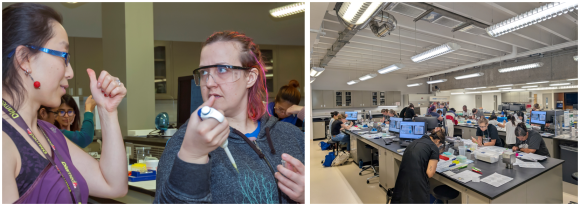
Buckley leverages those experiences when explaining to her students what science is like outside of high school. “Science after high school looks and feels very different, especially in biology,” she says. “It's very memorization based, and you are not probing for broader patterns. That totally changes when you enter the university world of science.” She strives to communicate to her students that biology is not just for medicine and there are a variety of opportunities in the biosciences, both in the lab and in the field, as well as in academia and industry.
As ABE Canada grows, both Buckley and Han are seeing the tremendous impact the program has had on students. As one data point, Han says that she has seen an increase in the number of UTM students wanting to work with the ABE site who have previously participated in the ABE program in high school. “Seeing these feedback cycles is really neat,” she says, as the students come into the university feeling they can see themselves in science careers.
Indeed, Buckley is still in touch with students from the first cohort who did ABE labs in her class at her previous school, and several of them have decided to pursue careers in research, medicine, or biotechnology. They often point to hands-on labs as a key motivator. “My students will say things like ‘we probably, cumulatively, in our high school career, never have as many labs as we have in your one course.’”