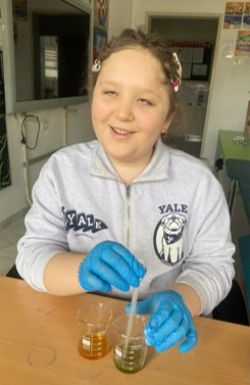
“Using a micropipette may seem like an ordinary laboratory activity for many students; however, for a student like me—who rarely has the chance to interact with scientific tools not designed with accessibility in mind—it was an unforgettable experience.
In the activity, I used the micropipette to draw colored liquid from small tubes and transfer it into empty ones. At first, I made mistakes, but with repetition—and with my teacher’s patience and encouragement—I learned how to use the micropipette and gained confidence. Soon, the process felt completely natural. I was so moved by the experience that I even dreamed about pipetting that night—repeating the steps again and again, while feeling proud, excited, and hopeful. It is a moment I will never forget.” –Excerpt from a letter by Ada Karakocaoğlu, ABE Türkiye student
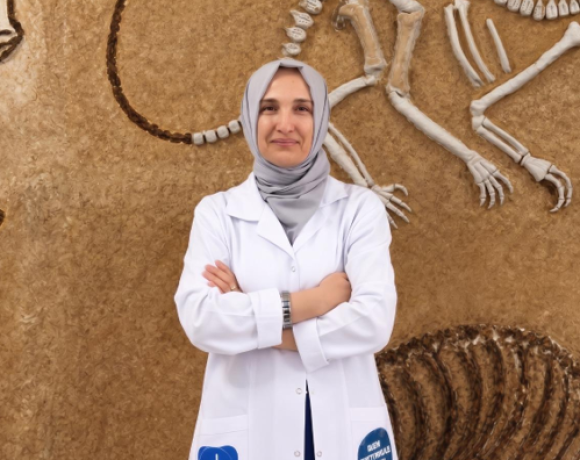
It was also a moment ABE Türkiye teacher Müşerref Dalkılıç would never forget. An ABE Master Teacher Fellow, Dalkılıç has been working to put scientific tools and processes into the hands of everyone, including gifted and visually impaired students like Karakocaoğlu. But she has not been working alone: Teams of students have worked alongside her to develop new ways to make hands-on science more broadly accessible.
The work is part of a 5-year plan Dalkılıç is implementing to give her students, who are part of an afterschool program for gifted students in Türkiye, the opportunity to learn about biotechnology through the ABE labs while also working to adapt and improve the materials for other students, says Elif Adıbelli Şahin, site director for ABE Türkiye. Dalkılıç’s goal, Şahin says, is to enable all her students to create useful, meaningful products that meet societal needs.
At any given time, Dalkılıç is working with 100 to 150 students in smaller teams on projects ranging from designing new types of micropipettes to developing songs that encourage mastery of the materials. She even has separate teams of students to implement the ideas, including those who worked with Karakocaoğlu to test lab adaptations for visually impaired students.
“These students feel more ownership after such an experience, and they really have more motivation,” says Dalkılıç, as translated from Turkish by Adıbelli Şahin. “By giving such opportunities to your students, they have other achievements, such as leadership and confidence, and not only cognitive outcomes.”
Creating such a rich environment for learning has not been without its challenges, Dalkılıç explains. When she first wanted to work on science materials for the visually impaired, for example, she recalls creating a dinosaur fossil at a very large scale. She assumed that a larger size would make it easier to perceive. But during the implementation, she and her students realized that the opposite was true.
“I needed to have some technical knowledge from the literature about visually impaired students to realize that they actually need minimal materials to best understand,” Dalkılıç says. “Sometimes you have some assumptions that are not true.”
Since that time, Dalkılıç has worked with her students to use minimal amounts of braille alongside creative presentations to reach students like Karakocaoğlu. This includes using beads to demonstrate states of matter, with beads spaced out farther apart for gases than for liquids and packed more tightly for solids.
Working with gifted students in a less traditional environment, Dalkılıç has been able to implement ABE labs to younger students than such labs would normally be taught in Türkiye. In addition to working with middle-school-aged children, she also works to differentiate the materials with her students. For example, while a typical DNA isolation lab might involve a banana, her students have done the lab with multiple pieces of produce and then compared the protocols. In another example, some of her students are now working to integrate machine learning and artificial intelligence into their work, including developing a lab assistant system for visually impaired students in a laboratory setting.
“Being an ABE teacher has had a profoundly positive impact on her life,” Adıbelli Şahin says of Dalkılıç. “She is someone who loves her profession and truly enjoys producing meaningful work, and in that regard, ABE has provided her with the inspiration and opportunities she needed.”
Indeed, Dalkılıç says, “Reaching a teacher who has a passion for learning and teaching is like reaching thousands of children. It creates a really powerful domino effect.” She is looking forward to seeing how that domino effect positively affects Karakocaoğlu and the many other students she has touched with her efforts.
Read the full letter from Karakocaoğlu.